
Unwanted Shopify traffic keeps arriving from one country, but the individual internet addresses behind it are not the same. Should you block the country, or start collecting IP addresses one by one?
The right answer depends on what your decision is really about. Country blocking matches a geographic policy. IP blocking matches a specific address or address range. When the stable signal is an unserved country and your goal is to stop that region from browsing the storefront, ShieldLeaf turns that decision into one readable country rule.
Leafy’s Quick Answer
Use country blocking when the boundary applies to everyone detected in a selected country. Use IP blocking when you have evidence tied to an exact address or network range and a security layer that can enforce it. ShieldLeaf is intentionally the country route: choose a country, preview a blocked page or redirect, and turn the rule on without maintaining an IP list.
Country blocking and IP blocking match different things
The two controls are related, but they are not interchangeable.
| Match the evidence | Choose |
|---|---|
| The storefront policy applies to an unserved or unwanted region | Country blocking: match a country inferred from the visitor’s network location |
| A known source or network is tied to a specific problem | IP blocking: match one exact IP address or a defined address range |
Shopify explains in its Markets localization guidance that a visitor’s first geographic location is determined from their IP address. That is why the terms can sound identical. The difference is the rule you manage: a country blocker evaluates a location, while an IP rule evaluates the address or range itself.
Cloudflare’s IP-rule documentation makes the technical split explicit by treating IP lists and geography fields as different rule inputs. Shopify also says its storefront traffic already passes through Cloudflare protections such as WAF and DDoS controls. ShieldLeaf does not pretend to replace that infrastructure; it gives merchants a practical country-access decision inside Shopify.
Choose the signal that stays meaningful
Country blocking is the clearer choice when:
- you do not serve a country and do not want visits from it browsing the storefront;
- unwanted traffic repeatedly clusters in that country, even when individual addresses vary;
- the desired outcome is a clear blocked-access page or a useful redirect; and
- you want one country rule you can preview and review.
An exact IP rule is the narrower choice when logs identify one address or range behind a specific problem and your security setup explicitly supports that kind of rule. It is not a practical substitute for a geographic policy: a list of addresses says which networks to stop, not which country your storefront is meant to serve.
Leafy’s Watch-Out
“More precise” does not automatically mean “better.” An exact IP rule can be too narrow for a country-level decision, while a country rule can be too broad for one known source. Match the boundary to the evidence.
Turn a country decision into a ShieldLeaf rule
Suppose sessions repeatedly arrive from a country where you do not sell. The addresses are not a useful merchant workflow; the country pattern is. In ShieldLeaf, you can:
- choose the country you have decided not to serve;
- select a blocked-access page or redirect;
- preview the complete visitor experience before launch;
- enable the Shopify app embed and turn protection on; and
- review recent blocked activity when your plan includes activity logs.
The Free plan supports one active blocked country, either visitor outcome, and preview. Pro adds unlimited countries, groups and presets, plus blocked-visit activity logs. ShieldLeaf keeps raw IP addresses out of stored activity because its merchant-facing job is the country decision, not a growing address list.
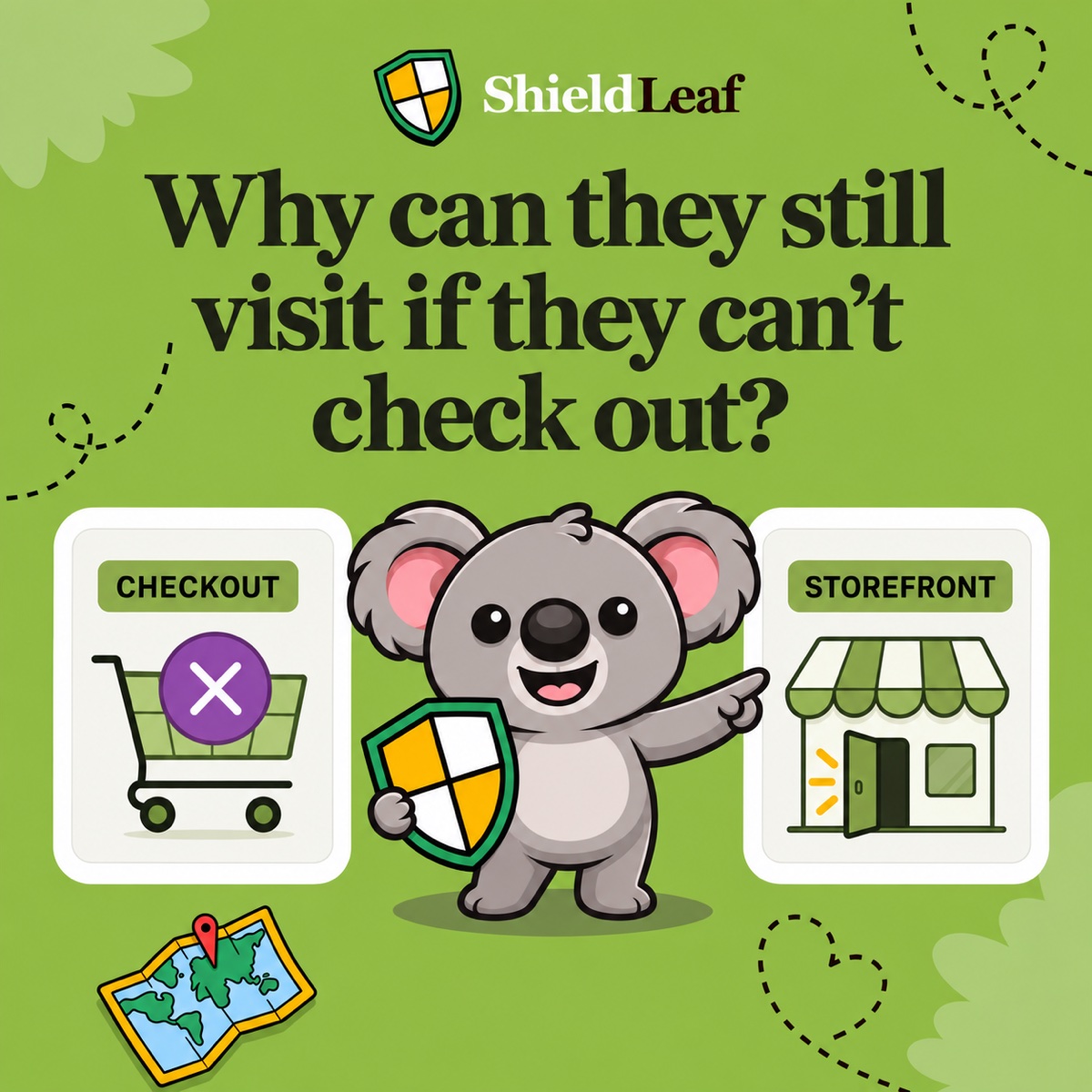
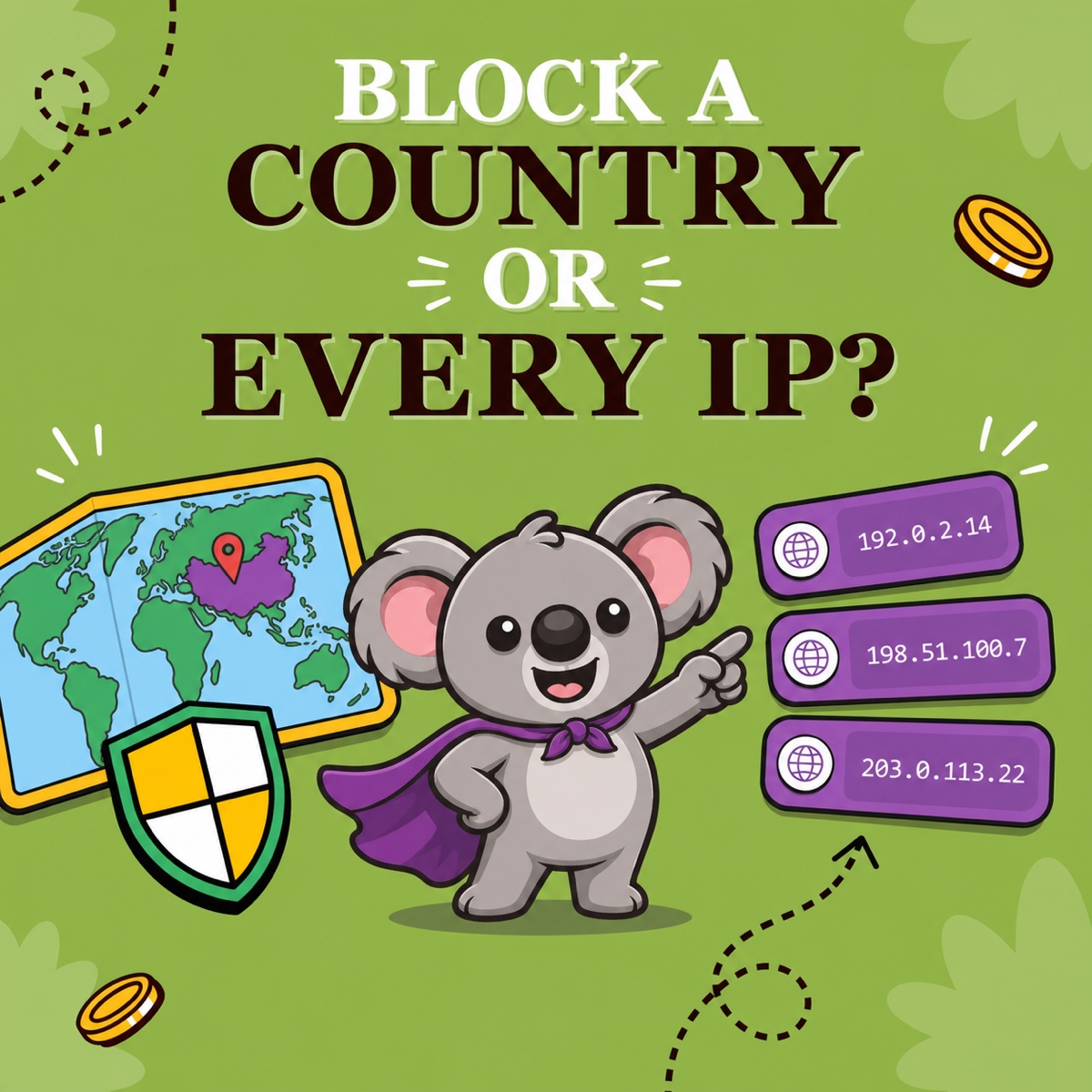
If the requirement is only to stop checkout, Shopify Markets may be enough; our country-blocking guide explains that separate boundary. If the requirement is to handle selected regional traffic at the storefront, the useful memory cue is the artwork’s question: block a country or every IP? Choose the level that matches the policy, then test the actual visitor outcome.
Country detection is not identity proof. Shopify warns that VPNs, corporate networks, and some mobile carriers can be detected in the wrong place. ShieldLeaf therefore does not claim WAF-level, VPN-proof, scraper-proof, or bot-proof blocking. It offers a focused, previewable country rule for the regional traffic you have deliberately decided not to serve.
Turn a country-level decision into a focused ShieldLeaf rule.