
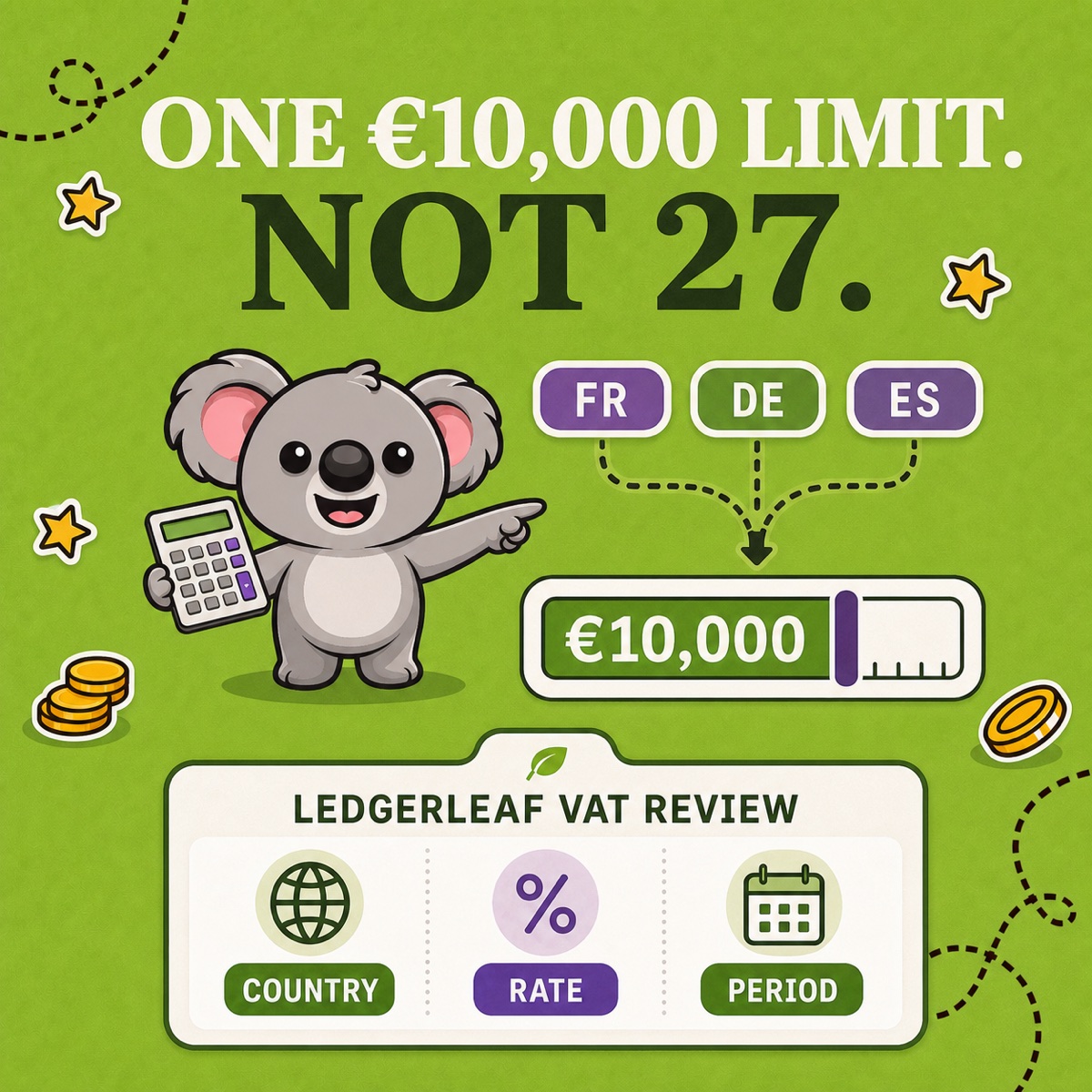
The EU distance-selling threshold is not €10,000 for France, another €10,000 for Germany, and so on. It is one combined EU-wide threshold of €10,000, excluding VAT, for qualifying cross-border B2C supplies. For an eligible EU-established merchant, crossing it changes the place-of-supply rule: destination-country VAT applies instead of the home-country treatment.
The number is only the trigger. Once destination VAT applies, you need evidence by country, rate, period, and transaction. That is where LedgerLeaf Pro becomes the practical Shopify workflow—not to decide your registration, but to make the VAT result reviewable and exportable.
Leafy’s Quick Answer
Add qualifying intra-EU distance sales of goods and cross-border telecommunications, broadcasting, and electronic services across all EU destination countries. The total must not exceed €10,000 in both the current and preceding calendar year for the threshold simplification to remain available. Confirm your scope with your tax authority or advisor; then use LedgerLeaf to review the Shopify VAT evidence by country and rate.
This is general operational guidance, not tax advice. Establishment, warehouses, sales channels, customer status, product type, and registrations can change the answer.
One threshold, three common mistakes
The European Commission’s One Stop Shop guidance sets out the conditions behind the headline number.
| Mistake | What the rule actually tests |
|---|---|
| “Every EU country gives me €10,000.” | The threshold is combined across qualifying EU destinations. |
| “Only my Shopify goods count.” | Qualifying cross-border TBE services share the same threshold, and relevant sales outside Shopify can matter too. |
| “The counter resets cleanly on 1 January.” | The total must stay within €10,000 in the current and preceding calendar year. |
The simplification is narrow. It generally requires the supplier to be established in only one EU Member State and the qualifying goods to leave that Member State for consumers in another. It does not apply to imported-distance sales, and a merchant may choose destination taxation below the threshold; the Commission says that choice binds the merchant for two calendar years.
A €10,200 Shopify example
Suppose an Italy-established store has qualifying cross-border B2C sales excluding VAT of:
- €4,000 to France;
- €3,500 to Germany; and
- €2,700 to Spain.
No country reaches €10,000. Together they reach €10,200. Assuming the threshold conditions apply and no other transaction changes the calculation, the general destination rule applies as soon as the combined threshold is exceeded.
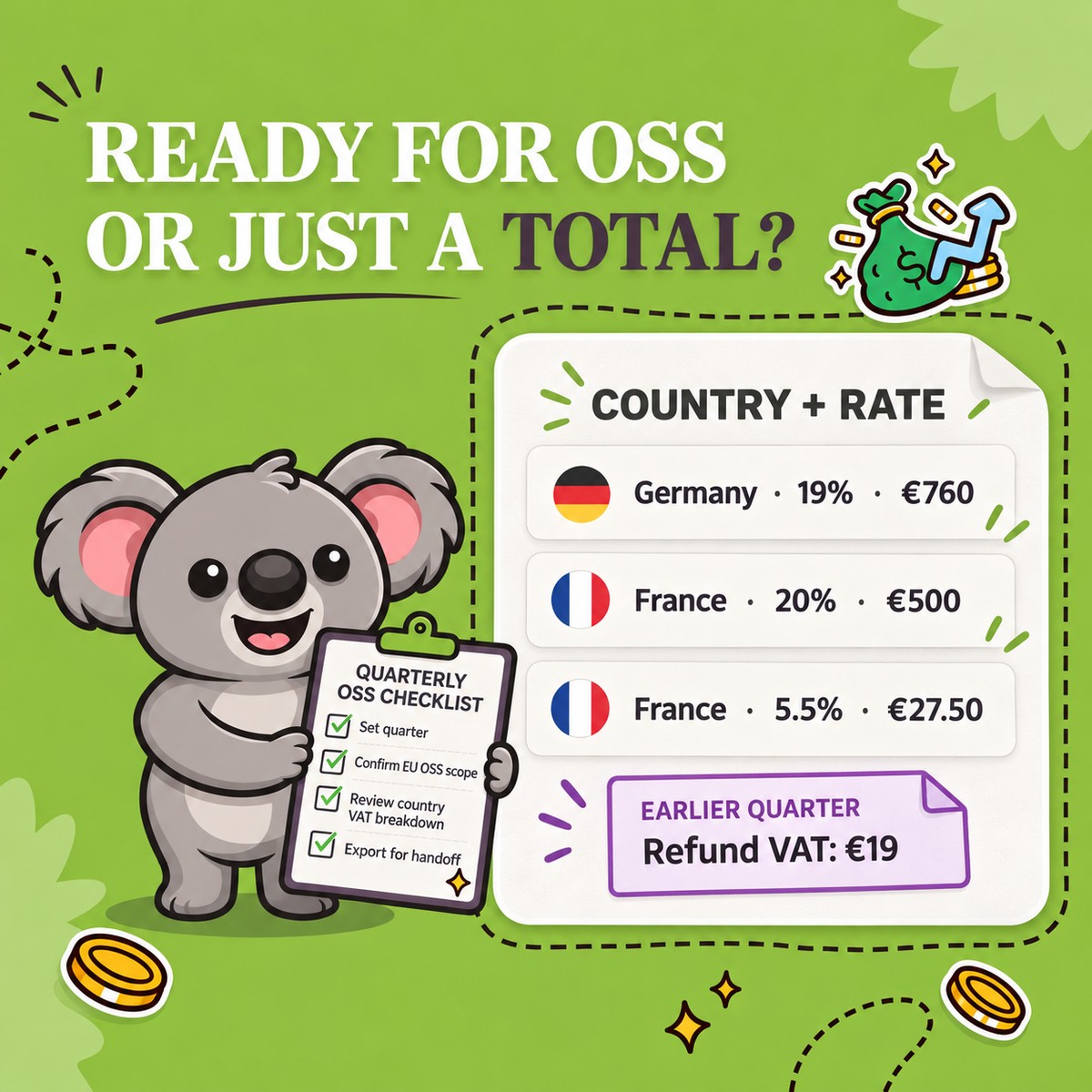
This is the moment a single “EU sales” total stops being enough. The merchant now needs the French, German, and Spanish sales separated with their applicable VAT rates and a trail back to the underlying orders.
Turn the threshold into a LedgerLeaf workflow
1. Confirm the trigger outside the app
Create one calculation covering all relevant channels, qualifying goods and TBE services, and both the current and preceding calendar year. LedgerLeaf is a Shopify reporting tool; it should not be treated as the authority that determines whether the legal threshold applies.
2. Update Shopify only after registration is confirmed
Shopify’s current EU tax setup guidance distinguishes home-country, OSS, and country-specific registrations. Confirm the correct route with the relevant authority or advisor, then keep the registration in Shopify aligned with that decision.
3. Make LedgerLeaf the destination-VAT review surface
In LedgerLeaf Pro, set the exact period, apply the EU OSS scope and payment-status filters when relevant, and review VAT by destination country and rate. Trace an unexpected rate, refund, or zero-tax row to transaction detail before exporting the OSS-by-country CSV and tax CSV or XLSX.
LedgerLeaf turns “we crossed €10,000” into the evidence the next VAT review actually needs: which country, which rate, which period, and which Shopify transactions. Without that second step, the threshold calculation identifies a change but leaves the merchant to rebuild the reporting trail by hand.
Leafy’s Watch-Out
Stock in another Member State, more than one establishment, B2B sales, marketplaces, or non-EU dispatch can create a different route. Treat €10,000 as a scope question before treating it as a Shopify setting.
The memorable rule is simple: one €10,000 EU-wide threshold, then a country-by-country VAT review.